
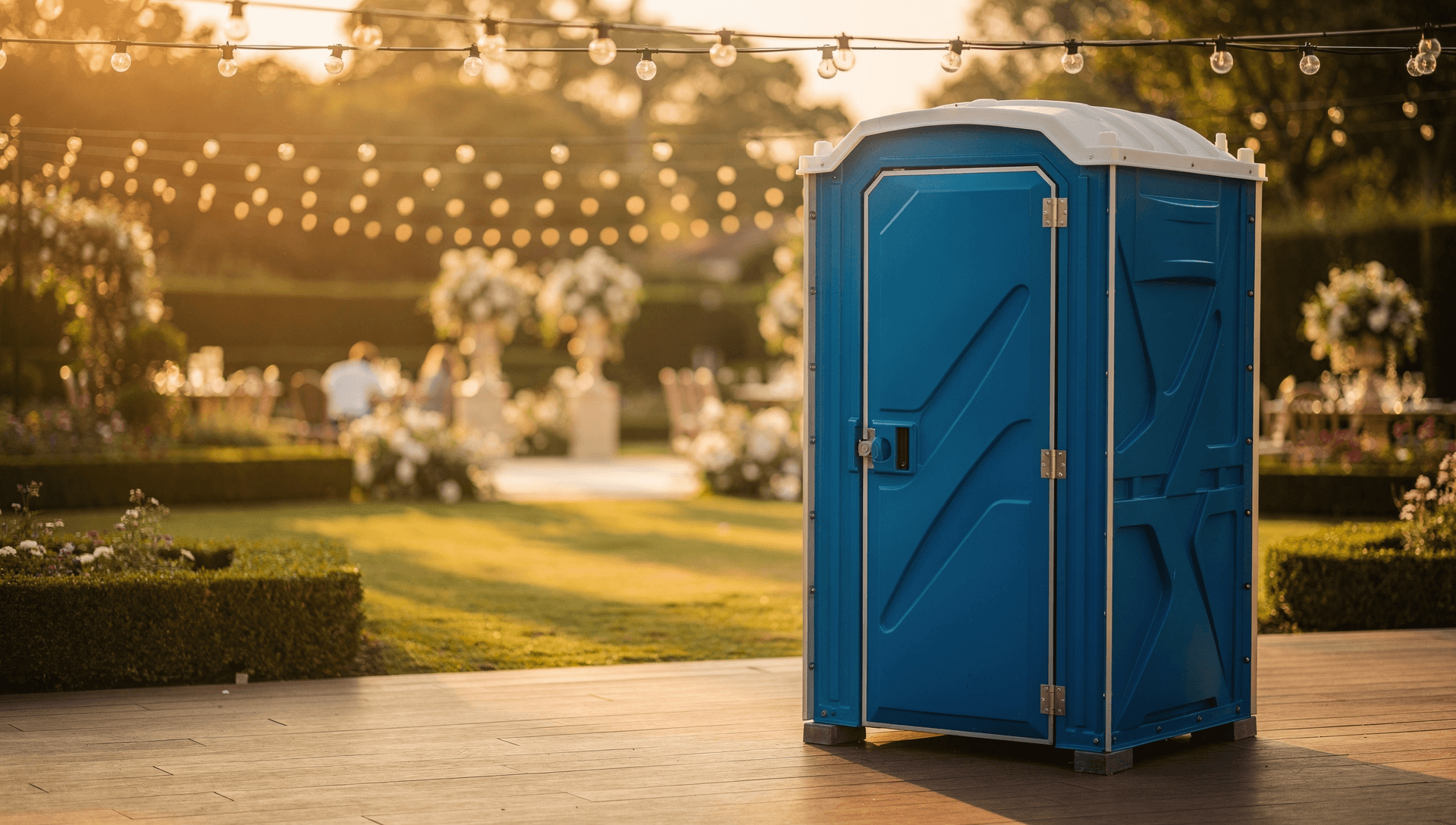
How Does a Porta Potty Work? (Inside Look + Waste Q&A)
A porta potty collects waste in a sealed holding tank beneath the seat. Enzymes and biocides in the blue liquid break down solids, suppress odor, and keep the tank viable between weekly pump-outs. Here's the full inside look — chemistry, servicing, and where the waste goes.
A porta potty works by collecting waste in a sealed polyethylene holding tank below the toilet seat. A blue chemical solution — containing biocides or bacterial enzymes, dye, and fragrance — actively breaks down solids, suppresses odor-causing gases, and keeps the tank contents stable between service visits. There is no plumbing connection. No flushing. No water supply required.
A service technician visits weekly (or more frequently for high-usage units), vacuums the tank with a pump truck, rinses the interior, restocks paper and hand sanitizer, and adds fresh deodorizer. The collected waste goes to a licensed wastewater treatment facility — the same place your home sewage goes.
The basic mechanism: how a porta potty actually functions
Modern portable toilets are elegantly simple. There are only four main components that matter mechanically:
- The housing: A rotationally-molded high-density polyethylene (HDPE) shell — the same material used for fuel tanks and industrial containers. HDPE is UV-resistant, doesn't corrode, and is non-porous enough to be sanitized with a pressure washer. The outer walls are typically double-paneled for structural rigidity.
- The holding tank: An integrated tank beneath the floor, sealed from the interior by the toilet seat flap. Volume typically runs 50-70 gallons, and service timing depends on usage intensity, weather, rental duration, and event conditions.
- The seat and flap: The toilet seat opens over a hinged trap door. When you sit and use the toilet, waste drops through the flap into the holding tank below. The flap springs closed again, creating a partial odor barrier between the tank interior and the seat well.
- The vent stack: The vertical pipe running up the back exterior of the unit. This is passive — no fan. Warm air and gases from the tank rise naturally and exit at the top. This is the single biggest reason a well-placed porta potty smells better than you expect: the vent stack creates a continuous negative-pressure draw away from the seat.
That's the entire mechanism. No moving parts beyond the flap and door. No pumps. No electricity. No plumbing connection. A porta potty can be deployed anywhere a truck can reach and positioned on any level surface — which is why they're standard on construction sites, remote festivals, disaster relief operations, and anywhere permanent sanitation infrastructure doesn't exist or can't handle event capacity.
The blue liquid: what's actually in it
The blue liquid is not just dye and perfume. It's a multi-function chemical system doing several jobs simultaneously. Here's what's in a modern, formaldehyde-free porta potty deodorizer concentrate:
Biocides or bacterial enzymes (the active chemistry)
Older formulas used formaldehyde as the biocide — effective at killing odor-causing bacteria, but also toxic to wastewater treatment plant biology, carcinogenic with repeated worker exposure, and increasingly restricted by municipal treatment facilities. The industry has largely shifted to two cleaner chemistries:
- Quaternary ammonium compounds ("quats"): Broad-spectrum biocides that disrupt bacterial cell membranes. They're the same chemistry in most commercial disinfectant wipes. At holding-tank concentrations, they kill the anaerobic bacteria that produce hydrogen sulfide (H₂S) and ammonia — the two primary compounds responsible for the "sewage smell."
- Enzyme and bacterial blends: Instead of killing bacteria, these formulas introduce beneficial aerobic bacteria and digestive enzymes that break down solid waste and toilet paper faster. Products like Walex SD-100, BlueWorks, BluFusion, and Thetford's Aqua-Kem Blue (formaldehyde-free variant) use enzyme-forward formulas. These are gentler on wastewater plant biology and work particularly well in hot-weather conditions where fermentation accelerates.
Dye
The blue dye serves one purpose: masking. Blue + yellow = green, which reads visually as less contaminated than straight yellow or brown. This is a psychological lever, not a chemical one. Some newer products have moved to teal or green concentrates — same logic.
Fragrance
Added fragrance masks residual volatile compounds that make it past the biocide or enzyme action. Common scents in the industry: wintergreen, cherry, and "fresh linen" synthetic compounds. Fragrance doesn't do any of the actual chemistry — it's the last line of defense against odors the biocide didn't suppress.
Surfactants
Detergent-like compounds that help the solution wet and penetrate solid waste quickly, speeding up enzymatic breakdown and ensuring even distribution throughout the tank volume.
The concentrate is mixed with water at dilution ratios specified per product — typically 2-4 ounces of concentrate per gallon of water added to the tank. A standard service visit adds about 2-3 gallons of fresh deodorizer solution after the pump-out.
Where does porta potty waste go?
This is the question people are most curious about — and the answer is more rigorous than most expect.
Step 1: The pump truck collects it
A service technician arrives with a vacuum pump truck — a vehicle with a sealed holding tank (typically 800-2,500 gallons) and a high-powered vacuum system. The tech inserts a 3-inch hose into the porta potty's cleanout port, switches on the vacuum, and the entire contents of the holding tank — liquid, solids, paper, and deodorizer — get sucked into the truck's tank in under two minutes. The tech then adds a small amount of fresh water, agitates to rinse, and vacuums again. Then: fresh deodorizer, restocked paper, hand sanitizer refill.
Step 2: Transport to a licensed receiving facility
The truck hauls its collected waste — called "portable sanitation waste" or "non-hazardous liquid waste" in regulatory language — to a licensed wastewater treatment facility. Most commonly this is a municipal POTW (Publicly Owned Treatment Works) that has a dedicated "septage receiving station" — a covered dump station where trucks offload. This is regulated at the state and federal level; portable sanitation operators must have licensed disposal contracts and manifest paperwork for every load.
Step 3: Treatment at the wastewater plant
Once at the plant, portable sanitation waste goes through the same treatment process as household sewage — because it essentially is household sewage in concentrated form:
- Primary treatment: Settling tanks where solids sink out and floatable material (oils, grease) gets skimmed. The settled solids become "primary sludge."
- Secondary treatment: The liquid fraction goes through biological treatment — aeration tanks where oxygen-loving bacteria digest dissolved organic compounds. This removes 85-95% of biological oxygen demand (BOD).
- Final effluent: Treated water is disinfected (chlorine or UV) and discharged to surface water within EPA National Pollutant Discharge Elimination System (NPDES) permit limits.
- Solids processing: The combined sludge from primary and secondary treatment gets further processed — either into Class B biosolids for restricted agricultural land application, or Class A biosolids (higher-treatment product suitable for unrestricted use, including home garden products). Both are regulated under EPA 40 CFR Part 503, the federal biosolids management rule. Some plants use anaerobic digestion to process the sludge, capturing methane for energy generation in the process.
The blue deodorizer chemicals — primarily quaternary ammonium compounds or enzyme blends, both water-soluble — are compatible with municipal plant biology at the concentrations present in portable sanitation waste. This is one reason the industry has moved away from formaldehyde: formaldehyde was toxic to the biological treatment process itself.
How servicing works: what a service rep actually does
A weekly service visit for a standard porta potty takes about 8-12 minutes and follows a consistent protocol. Here's exactly what happens:
- Arrival and access: Tech parks the pump truck adjacent to the unit, connects the vacuum hose to the porta potty's cleanout port at the base of the tank.
- Vacuum pump-out: 60-90 seconds to evacuate the tank. The truck's onboard vacuum creates enough negative pressure to move dense solids. A good tech watches the color of what's coming through (clear = done) to confirm full evacuation.
- Rinse cycle: A small amount of clean water is added through the seat opening, agitated by briefly running the vacuum again, then vacuumed out. This removes residue from the tank walls and floor.
- Fresh deodorizer: The tech adds the correct dose of deodorizer concentrate + water per the product spec for that tank size.
- Interior wipe-down: Seat, walls, floor, and door handle get a spray of disinfectant and a wipe. This is the part most visible to users — a properly serviced unit has no visible contamination on any surface.
- Restock: Fresh toilet paper roll and hand sanitizer refill.
- Visual inspection: Tech checks for cracks, door latch function, vent stack obstruction, and any damage worth reporting. Units with structural issues get flagged for repair or swap-out.
For long-term rentals on multi-month projects, service frequency can be negotiated. See long-term porta potty rental for details on dedicated servicing schedules.
Why porta potties smell less than people expect
The visceral cultural association with porta potty odor is largely legacy — it's anchored to underfunded, over-capacity, or poorly-placed units from years past. A properly maintained unit at appropriate usage levels smells meaningfully less than:
- A public restroom with flush toilets that hasn't been cleaned in a few hours
- An airplane lavatory mid-flight
- A port-a-john at a stadium end-of-game (overcapacity + heat)
Why? Three mechanisms work in concert in a well-serviced unit:
- The sealed tank keeps odor below the flap. Unlike a flush toilet, where each flush aerates the bowl contents and the open bowl is exposed to room air, a porta potty's waste is physically sealed below the seat flap. You're smelling the flap seal area, not the tank itself.
- The blue chemistry actively suppresses the primary odor compounds. H₂S (rotten egg smell) and ammonia are both byproducts of anaerobic bacterial activity. The biocide or enzyme blend keeps that bacterial activity suppressed between visits.
- The vent stack creates passive negative pressure. Any odor that does escape the tank rises via convection through the back vent stack and exits at the top — away from the seat opening. On a warm day with any ambient breeze, this passive airflow is surprisingly effective.
Odor problems almost always trace back to one of four causes: over-capacity use, delayed servicing, direct solar heat exposure, or introduction of bleach or other cleaning chemicals that neutralize the deodorizer chemistry.
Are porta potties safe?
Yes — with appropriate hand hygiene. Let's be specific about the actual risk vectors:
Fecal-oral transmission
This is the real risk in any shared restroom. Pathogens like E. coli, norovirus, and Giardia are shed in feces and can cause illness if they reach another person's mouth via contaminated hands. The CDC's guidance is consistent: wash or sanitize hands after any restroom use. The hand sanitizer provided at porta potties eliminates the primary transmission route. This risk is not meaningfully higher in a porta potty than in any other public restroom.
Splash-back
Contrary to intuition, splash-back is lower risk in a porta potty than in a flush toilet. The liquid surface in the holding tank is 12-18 inches below the seat — far lower than the water surface in a standard toilet bowl (typically 6-8 inches below the seat). This distance dramatically reduces aerosol generation. Flush toilets, by contrast, generate aerosol plumes ("toilet plume") with each flush that have been documented to carry viral particles. Porta potties don't flush.
STD transmission
No credible evidence exists for STD transmission from porta potty use. The pathogens responsible for sexually transmitted infections (HIV, gonorrhea, chlamydia, syphilis, herpes) are fragile on hard surfaces — they survive seconds to minutes in ambient conditions, not the hours between users. The CDC's guidance on this is clear: toilet seat transmission of STDs is not a documented transmission route.
Bottom line
A well-maintained porta potty is a sanitary restroom facility. The risk profile is comparable to any public restroom. Use the hand sanitizer. Don't touch your face inside. That's the protocol — the same one that works everywhere else.
How to make a porta potty smell better: what actually works
If you're managing units for an event, construction site, or long-term project, these six measures produce real results:
- Increase service frequency. The single most effective lever. If usage is running above 10 users per day per unit, weekly service is insufficient — the tank fills faster than the chemistry can handle. Request twice-weekly or 3x-week service from your provider. The incremental cost is typically $40-$80 per extra visit.
- Position units in shade. Solar loading on a black or dark-blue unit can raise internal tank temperatures by 20-30°F above ambient on a clear summer day. Higher temperature accelerates anaerobic fermentation — the process that produces H₂S and ammonia. Shaded units run measurably less odorous between service visits.
- Keep vent stacks clear of obstructions. The vent stack needs open air above and behind it to function. Don't place units against walls, in corners, or under overhangs that trap rising gases instead of letting them escape.
- Never add bleach or cleaning products. Bleach, pine cleaners, and ammonia-based products react with quaternary ammonium biocides and neutralize odor control. They also damage the tank coating. The only thing that goes in a porta potty is what it's designed for.
- Place hand sanitizer at the door, outside the unit. People are more likely to sanitize when it's social — when they're visible to others as they leave. Interior placement gets lower compliance. Higher hand hygiene compliance means less contamination transferred to interior surfaces, which means slower odor buildup between visits.
- Ask your provider about enzyme-based formula. In hot weather (above 85°F), enzyme-based formulas (Walex SD-100, BlueWorks) generally outperform quat-based formulas because enzymes remain active at higher temperatures. If your event is in summer, it's worth asking your provider which formula they use.
How many porta potties do you need?
For event planning, a common benchmark is 1 unit per 50-75 attendees for a daytime event with no alcohol. For construction sites, OSHA 29 CFR 1926.51 Table D-1 starts at 1 toilet facility for 20 or fewer workers, then scales by crew size. In practice, many contractors budget closer to 1 unit per 10 workers to avoid line delays. Use our calculator below to get a recommendation specific to your event or site size, duration, and use case:
Or call (866) 712-6719 — quotes typically come back in about a minute with pricing for your zip code.
How Porta Potties Work: FAQ
What is the blue liquid in a porta potty?
The blue liquid is a biocide-and-deodorizer concentrate diluted in water. Modern formulas are formaldehyde-free and use a mix of (1) quaternary ammonium compounds or bacterial enzymes to break down solid waste and toilet paper, (2) dye (blue masks yellow visually), and (3) fragrance to suppress odor. Major commercial brands include Walex SD-100, BlueWorks, BluFusion, and Aqua-Kem (Thetford). The solution sits in the holding tank — not in the seat well — and gets agitated slightly each time the toilet flap opens.
Where does porta potty waste go after servicing?
A service technician pumps the holding tank with a vacuum hose into a sealed pump truck. The truck hauls the waste to a licensed wastewater treatment facility — typically a municipal wastewater plant. From there, waste goes through (a) primary settling, (b) secondary biological treatment (aeration + bacteria), and (c) either discharge to waterways within EPA permit limits, or further processing into Class A or Class B biosolids for land application as fertilizer — regulated under EPA 40 CFR Part 503. The blue chemical is water-soluble and compatible with municipal plant processes.
Do porta potties smell as bad as people expect?
Usually not, when properly serviced. A well-maintained unit at appropriate usage levels smells noticeably less than a public restroom without a flush — because the holding tank is sealed below the seat and the blue chemistry actively suppresses hydrogen sulfide (H₂S) and ammonia, the two primary odor compounds. The vent stack on the back of the unit creates passive airflow that draws odor up and out. Problems arise when: (1) the unit is over capacity, (2) servicing is delayed, (3) the unit sits in direct sun for hours, or (4) someone pours chemicals (bleach, cleaning products) in — bleach reacts with the biocide and breaks odor control.
How often does a porta potty need to be serviced?
The common baseline is once per week for light-to-moderate use. Each service visit includes vacuum pump-out of the holding tank, fresh water rinse of the interior surfaces, restocking toilet paper, refilling hand sanitizer, and topping up deodorizer. Higher usage rates require more frequent service. See our service frequency guide or long-term rental page for service-frequency options.
Is it safe to use a porta potty? Can you get sick from one?
Yes, porta potties are safe with proper hand hygiene. The primary transmission risk in any shared toilet is fecal-oral contact — touching contaminated surfaces then touching your mouth. The CDC's standard guidance applies: use the hand sanitizer provided, don't touch your face inside the unit. There is no credible evidence of STD transmission from toilet seats — pathogens causing STDs do not survive on hard surfaces. Splash-back risk is lower in porta potties than flush toilets because the liquid surface in the tank is farther from the seat. Bottom line: the risk profile is comparable to any public restroom; the hand sanitizer on the door is the key control.
Why does the holding tank have blue liquid and not just water?
Plain water alone would create a septic-like anaerobic environment that produces methane and hydrogen sulfide — the same gases that make septic tanks smell. The blue chemistry does four things water can't: (1) suppresses microbial H₂S and ammonia production via biocide or enzyme action, (2) breaks down solids and toilet paper faster so the tank volume lasts longer between pump-outs, (3) visually masks waste color (blue + yellow = green, less viscerally offensive), and (4) inhibits the fly population that would otherwise breed in standing waste. Formaldehyde-based formulas did all this for decades but have been largely phased out in favor of quaternary-ammonium and enzyme-based formulas that are safer for workers and compatible with municipal wastewater treatment plants.
How do you make a porta potty smell better?
Six things that actually work: (1) Add more servicing visits — the #1 lever; if usage is heavy, bump from weekly to twice-weekly service. (2) Position in shade — solar heat is the leading cause of odor acceleration; shaded units run measurably cooler and slower-fermenting. (3) Keep the vent stack clear — don't place units against walls or fences that block the back vent. (4) Never pour bleach or cleaning products in — bleach neutralizes the deodorizer chemistry and makes odor worse. (5) Place hand sanitizer outside the door, not inside — this gets more people to actually sanitize (social proof), which reduces interior contamination. (6) Ask your provider to use enzyme-based formula (e.g., Walex SD-100 or equivalent) — these work better in hot conditions than older formaldehyde-era formulas.
Are porta potties better or worse for the environment than flush toilets?
On water use, porta potties win clearly: a standard flush toilet uses 1.28-1.6 gallons per flush (EPA WaterSense). A porta potty that gets serviced once per week with ~2-3 gallons of rinse water for 50-100 uses uses roughly 0.03 gallons per use vs. 1.5 gallons per use for a flush toilet. On waste treatment, the outcome is similar — both routes send waste to a licensed wastewater treatment facility. The one area where porta potties can lag: pump-truck diesel emissions for weekly service runs. But for temporary or remote-site use, they are the environmentally correct choice vs. trucking in water for flush-toilet infrastructure.
Related guides
- How much does it cost to rent a porta potty in 2026? — full pricing breakdown by unit type, duration, and region.
- Comprehensive porta potty rental cost guide — deeper detail on pricing drivers and what's included.
- Porta potty rental — hub page with service options for every use case.
- Long-term porta potty rental — 3, 6, 12, and 24+ month contracts and servicing options.
- Construction porta potty rental — OSHA requirements, unit counts by crew size, long-term rates.
- Event and festival porta potty rental — ADA requirements, sizing formulas, overnight servicing.
- Porta potty rental calculator — get a unit count and pricing estimate for your specific event or site.
Ready to Rent? Get a Quote in About a Minute
Call now — local providers in your area, pricing comes back fast.
📞 (866) 712-6719 — Call Now for a Free Quote