
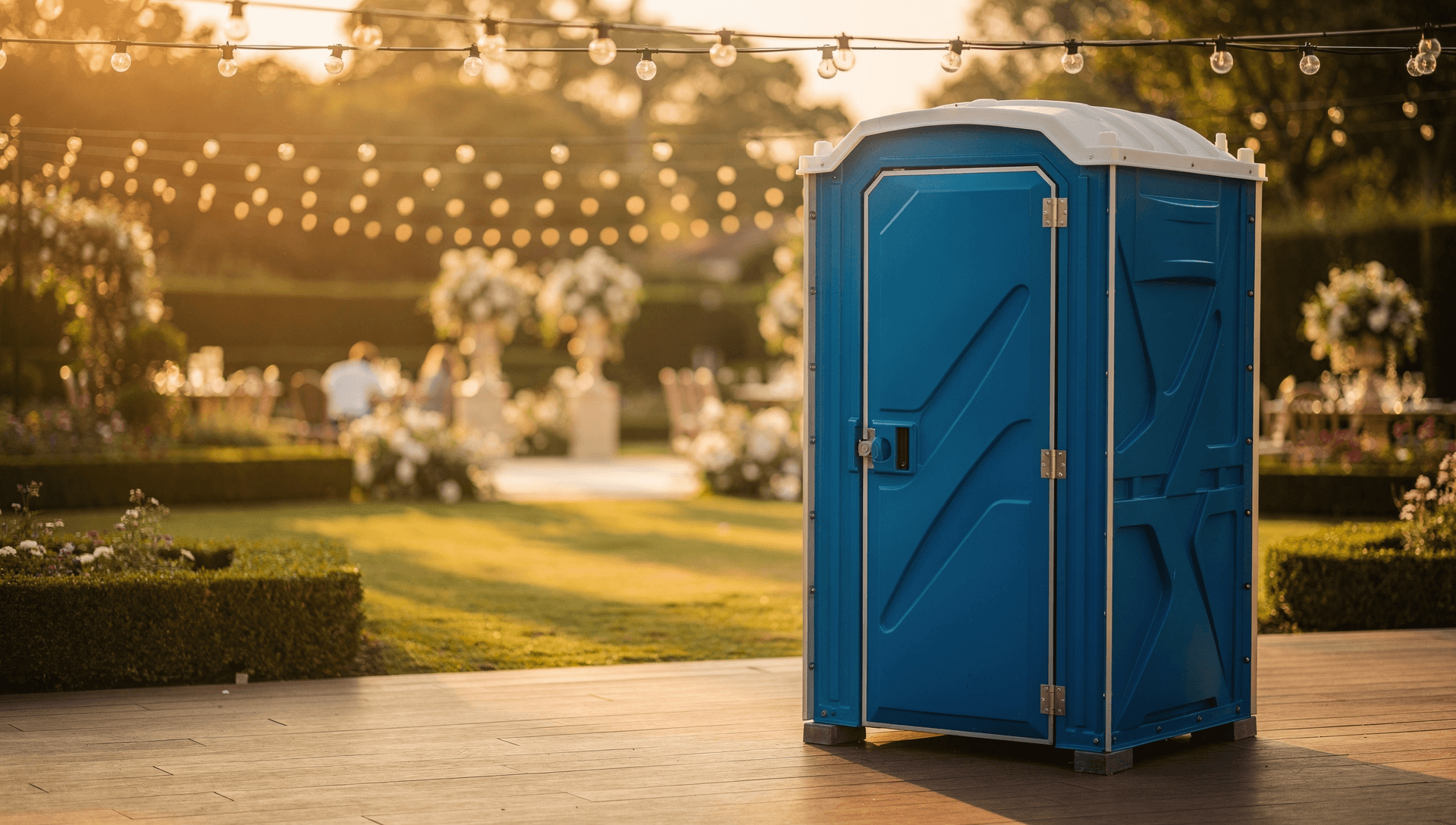
Porta Potty Dimensions Chart: Size, Weight & Tank Capacity
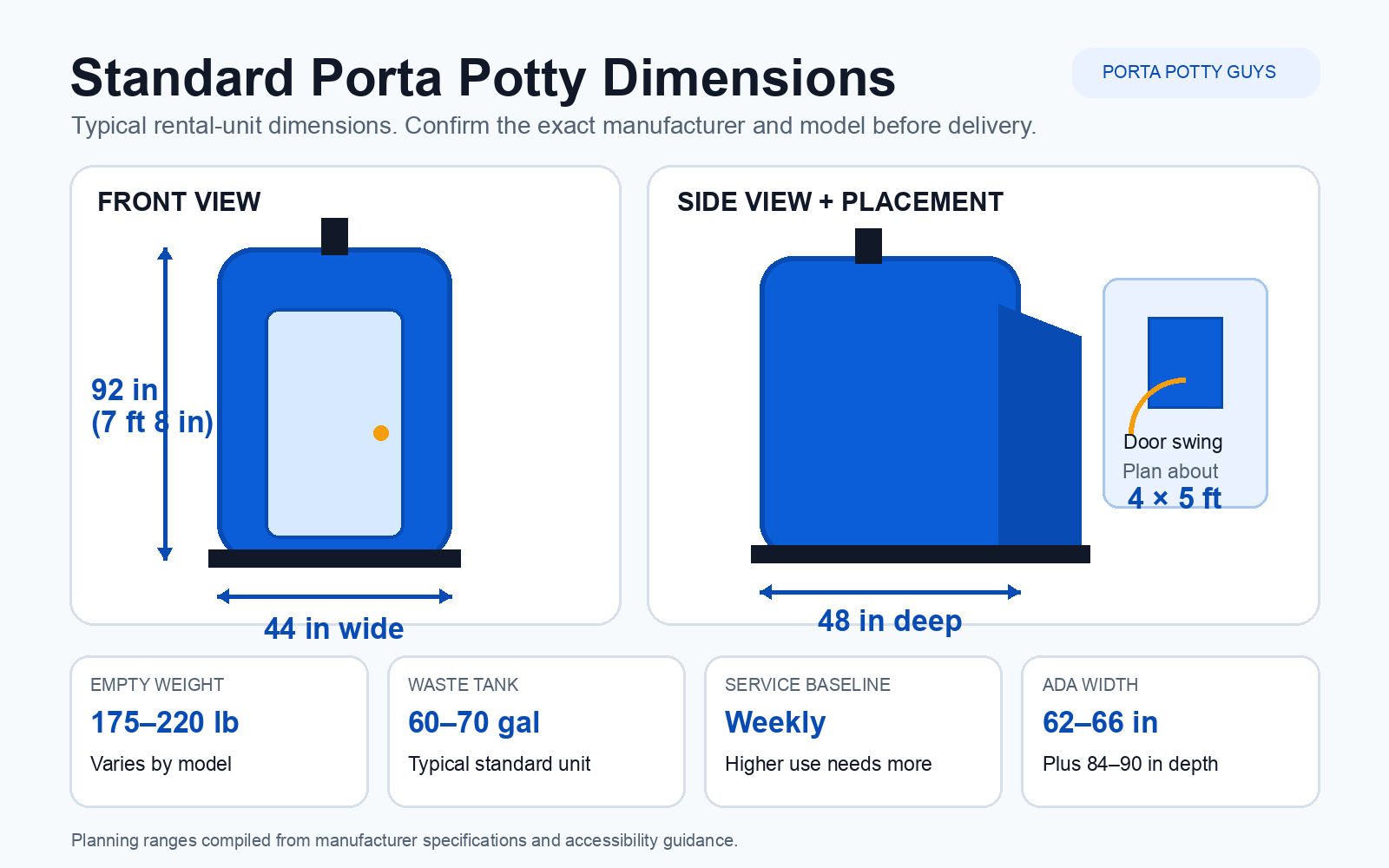
Standard porta potty dimensions are about 44 inches wide, 48 inches deep, and 92 inches tall. Use the chart below to compare standard, ADA, deluxe, handwashing, and restroom trailer specs before delivery.
A standard porta potty measures roughly 44" wide × 48" deep × 92" tall (about 3'8" W × 4' D × 7'8" H), weighs 175-220 lbs empty, and holds a 60-70 gallon waste tank. ADA-compliant units are wider at 62-66" to accommodate wheelchair turning, weigh 300-400 lbs, and require similar tank service intervals. Luxury restroom trailers run 11-32 feet long and 5,000-12,000+ lbs depending on stall count.
If you're planning delivery, the key logistics question is access: a standard unit delivery truck needs a gate or path at least 10-12 feet wide. Luxury trailers need a level, firm surface plus water and electrical hookups.
Porta potty dimensions at a glance
If you just need the basic porta potty size, use this quick read: standard single units are about 44 inches wide, 48 inches deep, and 92 inches tall. They fit on a roughly 4 ft x 5 ft placement footprint once door swing is included. ADA units need a much larger footprint, and restroom trailers need driveway-style access plus utility planning.
Why porta potty dimensions matter for your project
Choosing the right porta potty type isn't just about price — it's about whether the unit physically fits your site, whether the delivery truck can get there, and whether the unit will meet your legal requirements (especially ADA compliance at public events). The wrong choice means a unit that doesn't fit through the gate, a service truck that can't maneuver in, or an event with an ADA citation.
Below is a full specs comparison for every unit type you're likely to encounter, drawn from publicly published manufacturer catalogs (PolyJohn, Satellite Industries) and industry standards.
Porta potty specs comparison table
| Unit Type | Width × Depth × Height | Empty Weight | Tank Capacity | Typical Service Freq. |
|---|---|---|---|---|
| Standard | 44" × 48" × 92" | 175-220 lbs | 60-70 gal (waste) | 1× per week |
| Deluxe / Flushing | 44"-48" × 48" × 92" | 200-260 lbs | 60-70 gal (waste) + 15-25 gal (freshwater) | 1× per week |
| ADA-Compliant | 62-66" × 84-90" × 90-92" | 300-400 lbs | 60-75 gal (waste) | 1× per week |
| Handwashing Station | 30-40" × 30-36" × 72-80" | 75-120 lbs | 15-30 gal (freshwater) + 15-30 gal (gray) | 1× per week |
| Luxury Trailer (2-stall) | 11-14' L × 7-8' W × 9-10' H | 4,500-6,000 lbs | 50-100 gal (waste) + 50 gal (freshwater) | Per-event or daily |
| Luxury Trailer (4-stall) | 18-22' L × 7-8' W × 9-10' H | 6,500-9,000 lbs | 100-150 gal (waste) + 75-100 gal (fresh) | Per-event or daily |
| Luxury Trailer (6-stall) | 24-32' L × 7-8' W × 9-10' H | 9,000-12,000+ lbs | 150-200+ gal (waste) + 100+ gal (fresh) | Per-event; often continuous |
Sources: PolyJohn Industries product specs (polyjohn.com), Satellite Industries catalog (satelliteindustries.com), ADAAG for ADA unit requirements, manufacturer-published trailer specs. Ranges reflect variation across multiple models and manufacturers.
Standard porta potty height, width, and depth
The standard single-stall portable toilet has changed very little in exterior form factor since the modern plastic molded unit was standardized in the 1970s and 1980s. Major manufacturers including PolyJohn and Satellite Industries publish their unit dimensions on their public spec sheets:
- Exterior width: ~44 inches (3 feet, 8 inches)
- Exterior depth: ~48 inches (4 feet)
- Exterior height: ~90-92 inches (7 feet, 6 inches to 7 feet, 8 inches)
- Interior cabin (usable space): approximately 38-40" wide × 42-44" deep
- Door opening: typically 24-26 inches clear
The roofline vent — the black chimney-style protrusion on top — adds another 8-10 inches of height above the stated exterior dimension on many models. Plan for approximately 100 inches total clearance height if the unit needs to pass under a low overhead structure.
For placement purposes, each unit needs a footprint of roughly 4 feet × 5 feet (accounting for the door swing clearance in front) on a level surface. A 10-unit construction site setup needs approximately 200-250 square feet of level placement area if lined up side by side with door-swing room.
Standard porta potty weight: how heavy is a porta potty?
Empty unit weight for a standard portable toilet typically falls between 175 and 220 pounds. The exact figure depends on the manufacturer and model:
- PolyJohn Classic Series: approximately 185 lbs empty (per PolyJohn published specs)
- Satellite Industries Satellite® model: in the 175-200 lb range (per Satellite Industries catalog)
- Economy models from smaller manufacturers may be lighter (150-170 lbs); premium models with additional features may run heavier (210-230 lbs)
A full unit near service time is dramatically heavier. At a 60-gallon waste tank filled to capacity, with waste fluid weighing approximately 8.3 lbs per gallon, a full tank adds roughly 500 lbs on top of the unit's empty weight — meaning a standard unit at service time can weigh 650-720 lbs total. This is why service trucks use pump-out vacuum systems rather than physically moving full units.
Tank capacity: how much waste does a porta potty hold?
The waste holding tank on a standard portable toilet holds 60-70 gallons. Some compact or economy models run as low as 50 gallons; heavy-duty construction models may spec to 75 gallons. Most industry-standard units sold by PolyJohn, Satellite Industries, and similar manufacturers land in the 60-70 gallon range.
At light-to-moderate construction-site usage, a weekly service visit is the common contract baseline. Higher use, heat, food service, alcohol service, or multi-day public events can require extra pump-outs or more units. See the service frequency guide for the planning checklist.
For active jobsites, tank capacity is only one part of the quote. The construction site portable toilet rental guide ties unit count, weekly service, handwashing stations, and monthly contract pricing back to crew size. For local examples, compare the San Antonio construction rental page and New Braunfels construction rental page.
For events, the math changes significantly:
- A single standard unit at a 100-person outdoor event can fill in 2-4 hours if most attendees use it
- Event planning benchmarks often use 1 unit per 50-75 attendees for higher-use events, with that ratio adjusted for event length, alcohol, food service, and overnight servicing
- Large festivals with 5,000+ attendees need dedicated service trucks continuously cycling units, not just a once-per-week schedule
See our porta potty rental by capacity page for specific unit-count recommendations by attendee count and crew size.
Deluxe / flushing unit dimensions and specs
Deluxe or "flushing" portable restrooms have nearly the same exterior footprint as a standard unit — 44-48" wide × 48" deep × 92" tall — with a slightly heavier empty weight in the range of 200-260 lbs.
The additional weight comes from the freshwater system components: a separate freshwater holding tank (typically 15-25 gallons), a small pump, and the associated plumbing. Key capacity differences vs a standard unit:
- Waste tank: 60-70 gallons (same as standard)
- Freshwater tank: 15-25 gallons (for flushing + handwashing sink)
- Service includes: waste pump-out AND freshwater refill
Because deluxe units use water for each flush, the waste tank fills slightly faster than a standard unit at the same usage volume. Most providers account for this by checking fill level at each weekly service rather than always pumping to empty. For high-traffic deployments (weddings, corporate events), confirm that the quoted service frequency matches your expected usage — a 200-guest event using deluxe units may need 2× weekly service rather than the standard once-per-week.
Pricing comparison: see our standard vs deluxe vs luxury trailer guide and our 2026 porta potty cost guide.
ADA-compliant porta potty dimensions
ADA-compliant portable restrooms are significantly wider than standard units to meet the Americans with Disabilities Act Accessibility Guidelines (ADAAG) requirements for wheelchair accessibility.
Key ADA portable restroom specs:
- Exterior width: 62-66 inches (vs 44" for a standard unit)
- Exterior depth: 84-90 inches
- Exterior height: 90-92 inches
- Interior turning space: minimum 60-inch diameter clear circle (ADAAG requirement)
- Door clear width: minimum 32 inches (vs ~24-26" for standard)
- Toilet seat height: 17-19 inches AFF (above finished floor)
- Side grab bar: minimum 42 inches long, 33-36" AFF
- Empty weight: 300-400 lbs (significantly heavier due to larger structure + grab bar hardware)
- Waste tank: 60-75 gallons
The larger footprint means ADA units require more placement space — plan for roughly 6 feet × 8 feet per unit including door swing clearance.
When are ADA units legally required? Under ADA Title III, public events and temporary facilities must provide accessible portable restrooms. The general standard is at least 5% of units must be ADA-compliant, with a minimum of one ADA unit. For a 10-unit event deployment, at least 1 must be ADA-accessible. For 20 units, 1 is still the minimum (5% rounds down to 1). At 21 units, 2 are required. Always confirm local requirements — some municipalities enforce stricter ratios.
Luxury restroom trailer dimensions and specs
Luxury restroom trailers are in a different category from standalone units — they're road-towable trailers with finished interiors (climate control, real plumbing, mirrors, sinks, often wood floors and granite counters in premium models). Dimensions scale directly with stall count:
2-stall luxury trailer
- Length: 11-14 feet
- Width: 7-8 feet (exterior)
- Height: 9-10 feet (on wheels / parked)
- Empty weight: 4,500-6,000 lbs
- Waste capacity: 50-100 gallons
- Freshwater capacity: 40-60 gallons
- Best for: 50-100 guest weddings, small private events
4-stall luxury trailer
- Length: 18-22 feet
- Width: 7-8 feet
- Height: 9-10 feet
- Empty weight: 6,500-9,000 lbs
- Waste capacity: 100-150 gallons
- Freshwater capacity: 75-100 gallons
- Best for: 100-200 guest weddings, corporate events, film production
6-stall luxury trailer
- Length: 24-32 feet
- Width: 7-8 feet
- Height: 9-10 feet
- Empty weight: 9,000-12,000+ lbs
- Waste capacity: 150-200+ gallons
- Freshwater capacity: 100+ gallons
- Best for: 200-400 guest weddings, large festivals, VIP events
Site requirements for luxury trailers: Trailers need a level, firm surface (gravel, asphalt, or packed compacted soil — grass slopes won't work). Most also need a 20-amp 120V electrical hookup within 50-100 feet for HVAC and lighting, plus a potable water supply connection within 50-75 feet. Confirm both with your venue before booking — a trailer without power and water is an expensive standalone box.
Handwashing station dimensions and specs
Standalone handwashing stations are smaller and lighter than standard porta potties. They're frequently required by OSHA for construction sites (29 CFR 1926.51 requires handwashing facilities separate from toilet facilities when chemicals are in use) and by event health departments for food service areas.
- Footprint: 30-40 inches wide × 30-36 inches deep
- Height: 72-80 inches
- Empty weight: 75-120 lbs
- Freshwater tank: 15-30 gallons
- Gray water tank: 15-30 gallons (used wash water — must be pumped)
- Servicing: weekly freshwater refill + gray water pump-out (included in standard service contracts)
- Typical rental add-on cost: $35-$75 per week on top of the porta potty contract
A standard handwashing station has 2 sinks (some models 1 or 4) with foot-pump or push-lever operation — no electricity required for most basic models. Soap and paper towels are stocked at each weekly service visit.
Delivery logistics: what access does a delivery truck need?
Understanding porta potty delivery logistics prevents the most common day-of complications. Here's what the delivery crew needs:
Gate and path clearance
- Standard unit delivery truck: needs at least 10-12 feet wide × 14 feet tall clearance to maneuver a unit off the truck bed and set it in place
- Tight access (fenced yards, alley placements): many providers carry a manual pump cart that allows them to move a unit by hand through a narrower opening — typically 5-6 feet minimum width — but expect a $50-$150 difficult-access surcharge
- Luxury trailers: the tow truck and trailer combined can run 50-60 feet in length; the placement area needs to accommodate that turning radius plus the full trailer length once spotted
Surface requirements
- Standard units can be placed on grass, gravel, asphalt, or concrete — any reasonably level surface
- Soft or muddy ground may require plywood base pads to prevent the unit from sinking; ask your provider if this is an issue at your site
- Luxury trailers require a firm, level surface — avoid soft grass, slopes, or anything with more than a 3-5 degree grade
Service truck access
The vacuum/pump truck that performs weekly service is typically larger than the delivery truck — a 2-3 ton tanker with a 1,000-2,500 gallon waste storage tank. It needs the same 10-12 foot width clearance, plus enough room to extend a suction hose (typically 50-100 feet of hose, so it doesn't need to be right next to the unit). If your units are placed in a location the service truck can't reach, the provider may charge a difficult-access service surcharge in addition to the delivery surcharge.
For projects with complex access constraints, discuss placement logistics with your provider before confirming the order — most experienced providers have seen every scenario and will tell you upfront what's possible.
Ready to get a quote for your specific project? See our full porta potty rental guide, construction jobsite rental guide, or browse by capacity to find the right unit count for your crew or guest list.
Get a quote for the right unit type and size
Knowing the specs is step one — getting a price for your specific location, duration, and unit type is step two. Use the calculator below for a ballpark estimate by ZIP code, or call for an exact quote in about a minute:
Or call (866) 712-6719 — local providers are on the line and most quotes come back in under a minute.
Porta Potty Dimensions & Specs FAQ
How big is a porta potty?
A standard porta potty measures approximately 44 inches wide × 48 inches deep × 92 inches tall (about 3'8" W × 4' D × 7'8" H). The interior cabin footprint is slightly smaller — typically 38"-40" wide × 42"-44" deep — once wall thickness is accounted for. This gives a single occupant enough room to turn around and use the unit comfortably. ADA-compliant units are wider: 62-66 inches wide to allow wheelchair turning radius.
How heavy is a porta potty?
An empty standard porta potty weighs 175-220 lbs depending on the manufacturer and model. PolyJohn's Classic Series runs about 185 lbs empty; Satellite Industries' Satellite® is in the same range. A full unit — with a 60-70 gallon waste tank near capacity — can weigh 600-700 lbs total (waste fluid weighs roughly 8.3 lbs/gallon). ADA units run heavier empty at 300-400 lbs, and luxury restroom trailers range from 5,000 lbs for a 2-stall up to 12,000+ lbs for a 6-stall.
How much waste does a porta potty hold?
A standard porta potty waste holding tank holds 60-70 gallons. A lightly used unit can often be serviced on a weekly schedule, while high-traffic events, hot weather, alcohol service, food service, and larger crews can fill tanks much faster. That's why service frequency should be planned from expected use, not tank capacity alone.
What are the dimensions of an ADA-compliant porta potty?
An ADA-compliant portable restroom is typically 62-66 inches wide × 84-90 inches deep × 90-92 inches tall. The extra width accommodates the 60-inch minimum clear turning circle required by the ADA Accessibility Guidelines (ADAAG) for wheelchair users. ADA units also include grab bars (42" side bar minimum), a lowered toilet seat height (17"-19" AFF), and a wider door (minimum 32" clear opening). At public events, ADA Title III requires at least 5% of portable restrooms be accessible, with a minimum of one unit.
How wide does a gate or access point need to be for porta potty delivery?
A standard porta potty delivery truck typically requires a gate or access opening of at least 10-12 feet wide to maneuver the unit into position. The porta potty itself is only about 44" wide, but the truck and its hydraulic lift arm need clearance to swing and set the unit down. For tight placements (narrow alleys, fenced backyards, side-yard access), call ahead — most providers can use a manual pump cart for tight-access situations but may charge a difficult-access surcharge of $50-$150.
How big is a luxury restroom trailer?
Luxury restroom trailers vary significantly by stall count: a 2-stall unit is typically 11-14 feet long × 7-8 feet wide × 9-10 feet tall, while a 6-stall premium trailer runs 24-32 feet long × 7-8 feet wide × 9-10 feet tall. Weight ranges from about 5,000 lbs (2-stall) to 12,000+ lbs (6-stall). Because of their size and weight, restroom trailers require a level, firm surface for placement and typically need a 20-amp electrical hookup for HVAC and lighting plus a water supply connection.
How often does a porta potty need to be serviced?
The common baseline is once per week for light-to-moderate use. Each service visit usually includes pump-out of the waste holding tank, freshwater rinse, toilet paper and hand sanitizer restock, and a wipe-down of high-touch surfaces. Higher-use jobsites, hot weather, alcohol service, food service, and multi-day events often need extra pump-outs or more units. See our service frequency guide for the full planning checklist.
What size truck is needed to deliver a porta potty?
Porta potty service providers use one-ton to medium-duty flatbed trucks (typically Ford F-450/F-550 class or equivalent) with a hydraulic lift arm for setting units. The vacuum/pump truck used for servicing (pump-out) is typically a larger 2-3 ton tanker truck with a 1,000-2,500 gallon waste tank. For delivery-only on a tight access point, some providers use a pickup with a tow-behind trailer. For luxury restroom trailers, a Class 5-6 truck (26,000 GVW+) is usually needed to pull and spot the trailer.
Related guides
- How much does it cost to rent a porta potty in 2026? — full pricing breakdown by unit type, duration, region, and use case.
- How does a porta potty work? — the mechanics behind waste holding, ventilation, and chemical treatment.
- Standard vs deluxe vs luxury restroom trailer — when to upgrade and when to save.
- Porta potty rental by capacity — guest count and crew size recommendations, with unit count tables.
- Porta potty rental guide — everything you need to know about renting, from planning to pickup.
Get Dimensions Confirmed for Your Specific Site
Call now — providers answer in seconds and can confirm unit specs, access requirements, and pricing for your location.
📞 (866) 712-6719 — Call Now for a Free Quote